


Meaning Land of the Eesti; [Greek suffix ia = land of 🔍] The 11c Frugården (Swedish) runestone mentions Estlatum, and Scandinavian sagas and Viking runestones reference the region as Eistland, with the name appearing as Aistland in Gutasaga (13c.)
Possibly connected to the Aesti, a people mentioned by the Roman historian Tacitus in the 1c AD which may derive from Latin Aestuarii meaning Estuary Dwellers.

Estonians did not use the name for themselves, however, until the mid-19c when the term Eesti rahvas = Estonian people was popularized during the Estonian National Awakening. Prior to that the simple endonym Maarahvas, literally meaning land people or country folk was used.
A blend of Nordic & Eastern European influences, medieval towns, beautiful National Parks, and a vibrant digital culture, Estonia is an affordable and truly unique destination.
@ a glance essentials:
.

Language:
Estonian
-
Most Locals can speak English.

-


Water safety
Safe to Drink
Currency:
€ Euro
Local Transport
There is a bus network in large cities but smaller towns will require a car.


................................................... Estonian curses can be on the coarser side - but they do sometimes add a touch of artistry to their vulgarity like Sitanikerdis which essentially means 'piece of 💩' but translates more literally as a carving (in the sense of an artistically sculpted) piece of 💩
Creative Local Curses -

The Baltic🔍 land that would become Estonia has been inhabited since at least 9,000 BC after the last ice age. The early Bronze & Iron Age peoples, descended from the Kunda culture, quickly spread throughout the region† (even giving rise to future neighbor Finland's Finnish Language.) While a 4c AD Goth King claims (without evidence) to have conquered the Chuds (as the Slav's called them) the loosely united counties managed to rule themselves until the middle ages.
a bit of background...
CHECK OUT THE:
.....................The Estonian Islands, particularly Saaremaa, ( Ösel in Swedish) were sites of original Viking settlements as early as the 7-8c; called the Víkingr frá Esthland (Vikings from Esthland) with the Icelandic Sagas calling them Oeselians. (Both "esth" & "oese" being versions of "east")
FUN FACT:
Everything changed though, when the whole of the (mostly pagan) Baltics were targeted in the Northern Crusades. Denmark, separately, conquered the northern Maarahvas (meaning land people, as they named themselves) in 1219 and the southern region was soon split between Teutonic Germans & Holy Roman Empire crusaders. What would become Estonia & Latvia, became the Teutonic crusader state🔍 of Terra Mariana, (Latin: Land of Mary) and later Livonia, (Estonian liiv = sand.) Starting in the 13c it was under foreign rule continuously for 500 years with the Teutonic Order, Denmark, Poland, Lithuania and Sweden all ruling at least portions of future Estonia until, over course of the 18c, the entire territory was conquered by the Russians.
In the 19c a nationalist movement arose and, after the collapse of the Russian Empire🔍 in 1918, the Democratic Republic of Estonia was founded. However, in 1940 it was re-annexation by the now USSR. Soon a gorilla war was being waged against the Soviets that briefly liberated south🔍 Estonia just in time to be occupied by Nazi Germany and then be recaptured by the Russians as Estonia SSR in 1944. Estonia didn't regain independence until the 1987 Soviet perestroika, the Singing Revolution, Sovereignty Declaration of 1988 & the official founding of the 🔎Republic of Estonia in 1991.
† Despite being a Baltic State today, these were not tribes of Balts, like those further south in Lithuania & Latvia.
Must Try Local Cuisine:
Küüslauguleivad - strips of Rukki Leib (black rye bread) fried in butter
Sõir - soft caraway-flavored cottage cheese ∞ Verivorst - Estonian blood sausage
Vürtsikilu Suupiste / Spiced Sprats (small oily fish similar to sardines) cream cheese & garlic sandwich on rye
Seapraad Ja Hautatud Hapukapsad - roast pork w/ sauerkraut & carrot ∞ SültPork - savory jellied meat in broth.
Potato Salads like fuchsia Rosolje of pickled herring & beets or Eesti Kartulisalat - w/ carrots peas, sausage & apples
Hernesupp Suitsukoodiga -traditional soup of peas, onions & smoked pork bones
Mulgikapsad - stew w/ sauerkraut, barley & bacon ∞ Leivasupp - creamy, sweet bread / dense rye soup w/ raisins
Porridges like Kruubipuder† - of baked barley, Mulgipuder - of barley & potatoes, w/ bacon & onions
or Mannavaht - whipped/ frothy pink semolina & cranberry
Kali - traditional lightly fermented malty rye drink ∞ Kaneelirull - sweet cinnamon bun
Kamavaht - "dessert powder" of roasted rye, oats, pea & barley flour,
(stirred into yogurt or in chocolate bars w/ sugar-coated whipped cream & berries)
➿➰➿
† Dating to the Middle Ages

SEE
DO TRY
&
VISIT
What to Where to Why . . .
Surprising Finds:


Soviet Relics like:
📍 Linnahall - crumbling brutalist Soviet-era concrete landmark by the sea, used for the 1980 Moscow Summer
Olympics, (reminiscent of ancient Mayan pyramids and the old Swedish bastions)
📍 Pilot Cemetery🔍 | Ämari Air Force Base- Soviet graves with headstones made of airplane fins
📍 Underwater Prison Ruins | Rummu - limestone quarry lake where convicts worked; A prime location for divers.
📍 The Hara Submarine Base - decommissioned submarine base pier completely covered in graffiti art
📍 Kohtla Mining Park | Ida-Virumaa - shale mine turmed a theme park of sorts
📍 Museum of Soviet Vehicles | Järva-Jaani - rusted cars, trucks, & buses in a huge 'junkyard' field
[There's also a peculiar border irregularity, the Saatse Boot, a 1/2 mile Russian peninsula between Estonian towns of Lutepää & Sesniki, in the east,
where it's legal to temporarily enter Russia without a visa. The road between the towns goes directly through Russian territory; when the Soviet
Union dissolved it was decided people could still cross the Saatse Boot without showing documentation on three conditions; that
1) "they don’t walk, 2) don’t pick wild mushrooms, + 3) their car never stops moving.†
Plus a "closed" town, Sillamäe, once top-secret & left off of maps as it was a uranium production site. - Today it is a residential suburb.]
📍 Lasva Water Tower - an old, disused water tower repurposed as an art gallery with a piano staircase
📍 Ruhnu Lighthouse | Ruhna Island - erected 1877, still in working order, rumored to be designed by Gustave Eiffel
(of Eiffel Tower fame; there is no proof, but ot was ordered from a company in France.)
📍 Kingdom of Torgu | Saaremaa - due to a clerical error a micronation was formed in 1992, after Estonia gained
independence from the Soviet Union.†† Journalist / political activist Kirill Teiter
became the first/ only monarch to reign over the Kingdom of Torgu, with its own flag, a
coat-of-arms with a "snail-dragon" and its own currency, the "kirill," (fixed to the price
of a half-liter of local vodka.) The error was corrected officially in 1993 but Torgu flags
and coat of arms can still be seen throughout the former parish.
† The road is left over from 1944 when Estonia's border was drawn while part of the Soviet Union. There is a modern road that goes around the
boot but it's a 1/2 hour detour. If one does stop on the road a guard on one of the Russian spy towers may arrest you
†† The peninsula was divided into 2 municipalities, but civil servants forgot to include a ~49-sqr-mile area, leaving the 500-odd people who
lived in the area to take advantage of the mistake and start their own country.


My Favorite Spots:
📍 Islands of Saaremaa - with Kuressaare Castle 📸 (14- 16c) medieval Karja Church🔍
known for unique murals of a triskelion, & a pentagram, endless apples 📸, leaning
Kiipsaare Lighthouse, the Ninase Windmills, painted as local giants Suur Tõll & wife
Piret, and Kaali Meteorite Crater field that may have been home to an ancient cult
Hiiumaa - with a wood Eiffel Tower replica and small Hill of (hand-made twig) Crosses
Hullo - with Vormsi Cemetery🔍 of unusual wheel crosses & tiny white-washed St Olav Church
Mägipe Island with Kõpu Lighthouse, one of the oldest in the world, in continuous use since it was built in 1531 plus
Tahkuna Lighthouse. (Some fishermen of these Western Islands take visitors out on their boats) and, in Riga Bay,
the distinct culture of the women of Kihnu Island; a "Masterpiece of the Oral & Intangible Heritage of Humanity"†
📍 Pärnu Bay & Resort - with timbered 17c almshouse (foundation dating back to ~ 1250- 1350), 19c timber villas, Russian
style Transformation of Our Lord Church, a seaside 1920’s era spa w/ Võromaa smoke sauna tradition, plus Victorian
stone jetty built on a 17c seawall,†† legend says lovers who hold hands & kiss at the end remain together forever.
📍 Bog Walking Estonia is often called the “Land of Bogs,”) - unlike a typical hike, a guided tour uses floating bog shoes to
walk directly on the mossy, spongy terrain without sinking
📍 Unique museums in Lakeside Peipsiääre Parish; in Kolkja are the Chicory Museum, built in 1893 for the purpose of drying
chicory, (a plant native to Europe once common in food and drinks, like German "Prussian Coffee") and the (Russian)
Old Believers Museum (& Restaurant) a unique eatery of the "Onion Route." A bit to the south in the Samovar House
(Tea Museum) | Varnja, dedicated to the originally Russian samovars elevate tea service (metal urns for boiling water, often
decorated with detailed etchings and other ornamental embellishments) with workshops on 'the art of savoring tea,' plus, to
the north, Alatskivi Castle, c.1601 reconstructed in the 1880's into a Scottish style castle resembling Balmoral
📍 Piusa Sand Caves - the man-made mineral caves mined for glass-sand c.1920's, miners hand-carved the sandstone into
corridors and galleries with elegant vaulted ceilings that now house a massive bat colony of 3000+ bats of five different
species (scientists to come to Estonia to study them and the caves can be visited by tourists.)
† Karja: Little is known about these symbols or the church's origins, possibly constructed ~13 or 14c and originally dedicated to St. Catherine & St. Nicholas.
A triskelion, or triskeles, in this case of white, red & striped legs, is an ancient motif consisting either of a triple spiral of rotational symmetry or other patterns in triplicate emanating from a common
center. The spiral design can be based on interlocking Archimedean spirals, or represent three bent human limbs. It occurs in artefacts of the European Neolithic and Bronze Ages with continuation into
the Iron Age especially in the context of the La Tène culture and of related Celtic traditions
Ninase Windmills: Newlyweds bring stones painted with their names + marriage date to the giants for good luck
Kihnu Island: Historically, the men went to sea while women ran the island, producing handmade objects, games, dances, and music.
†† Said to have been built for an elderly townsman who wanted to be closer to the Moon & stars.

Most Known For:


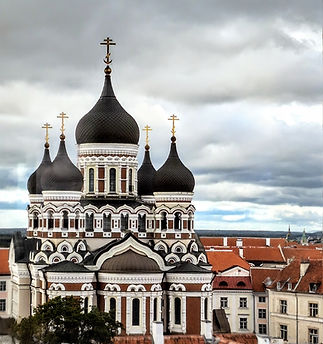
♦️ Tallinn 📸 - with Vanalinn (Old Town) one of the best preserved medieval cities in Europe
with Alexander Nevsky Cathedral🔍 & elaborate bells, Ichthus Art Gallery 📸 @
Medieval St. Catherine’s Dominican Monastery c. 1246. & Raeapteek 📸 - oldest
pharmacy in Europe selling medicine (& marzipan treats) since 1422.
🔸 Tartu - university (hipster) city with historic citadel, and ruins of a 13th c. cathedral 📸
& Soup Town (a neighborhood of old wooden homess)
♦️ National Park like Lahemaa; with raised bogs & Baroque Manor, Soomaa N. Park off the Raudna River (offering
canoeing & kayaking) Vilsandi N.Park on Saaremaa, Karula the country's smallest N. Park full of gently rolling
hills, or Haanja with the highest peak in the Baltics; Suur Munamägi plus nearby Pähni Megaphones | Varstu - 3
giant wooden megaphones deep in a forest that enhance the sounds of trees in the wind & birds, and the
Communication & Laptop Museum | Võrumaa, a small wooden cabin filled with telecommunications tech in the
middle of the wilderness
🔸 Tuhala Witches Well | Kose Parish - a karst spring, normally underground that overflows like a geyser occasionally,
for days, said to be caused by witches lashing each other underground (but actually caused by heavy rains.)
♦️ Runo Songs - traditional songs often performed in groups, creating a harmonious, powerful sound, tales of nature,
love or heroes, like the 19c national epic, “Kalevipoeg,” a collection of legends drawing from part history part
folklore of Kalevipoeg, (“Son of Kalev”) and his role in defending the Estonia

👀 NOTABLE ESTONIANS:
🔬 Karl Ernst von Baer | 1st Embryologist 🖥️ A. Heinla, P. Kasesalu, J. Tallinn, & S. Tamkivi | Skype Founders
(Karl Maksimovich Baer)
🎤 TOMM¥ €A$H | Rapper 🤼 Kaido Höövelson | Sumo Wrestler Baruto
👣

🌀 Jaanipäev/ St John Day / Midsummer (June 24) - a once pagan country with nature worship, the Feast
absorbed ancient solstice traditions like bonfires, the sauna & folklore tradition of children staying up until
dawn while staying up until dawn while young lovers search the forest for the lucky fern flower
🌀 Viljandi Folk Music Festival (July) - celebrates ancestral musical styles in the cozy lakeside town
🌀 Estonian Baltic Song & Dance Celebration (Summer every 5 years) - celebrating traditional Baltic heritage
🌀 Saaremaa Opera Festival (July) - most popular Baltic opera festival held @ the historic Kuressaare bishop's castle
🌀 Tartu Marathon - cross-country ski competition of Visma Ski Classics Pro Tour, but anyone can participate
Site Key:

Five Star Recommend
Make the Time!

Worth the Effort/ $


Going to visit
Make a DONATION of $5 or more and receive a FREE Thank You Gift of your choice of a FULL CITY TRAVEL GUIDE with even more favorites and the address/ contacts for all recommendations. Just include the NAME of the CITY in you're going to visit along with your EMAIL ADDRESS in the transaction description of your donation.
ESTONIA
ESTONIA

UNMOORED DETAILS DESTINATIONS PLAN YOUR TRIP ON A BUDGET TRAVEL BLOG
YOUR HOST- JULIA EUROPE PLANNING, PACKING & PASSPORTS HISTORY & CULTURE
SPECIAL THANKS AFRICA & MID EAST BOOK TRANSPORTATION MYTHS, LORE & LEGENDS
PRIVACY & TERMS OF USE ASIA & OCEANIA SLEEPING ARRANGEMENTS FRIENDS & ADVENTURES
CONTACT THE AMERICAS TRAVEL INSURANCE LOCAL FESTIVALS


Notices: Unmoored is not a licensed travel agency. The Site's intended to educate, inform & entertain and is not to be used as a source of official travel itinerary planning, or legal advice. It is merely the experiences and reflections of fellow traveler. - The site may contain affiliated links, (there is never any extra cost to you for using these links) but Unmoored only includes affiliated links for products/ companies that we would willing endorse on the site even without the affiliation.